:
: :
:

This article says:
- Creativity isn’t just about art – it strengthens cognitive skills, problem-solving and language development in everyday life.
- Small daily habits – stories, open-ended questions, play and routine choices – can nurture creativity without needing complicated resources.
- Creative activities can naturally complement speech therapy, helping children experiment with sounds, vocabulary and expression in a relaxed way.
- A school environment that values curiosity, imagination and holistic growth makes it easier for families to support creativity at home.
- Regent International School Malaysia combines the Cambridge curriculum with a strong focus on creativity, critical thinking and 21st-century skills, supported by the Global Schools Group network.

How to Support Creativity in Your Child’s Daily Routine
In a world full of schedules, tuition centres and test preparation, it’s easy for creativity to be squeezed to the edges of a child’s day. Yet creativity is essential – not only for future careers, but for problem-solving, resilience, cognitive skills and emotional wellbeing right now.
The good news? You don’t need to be an artist or buy expensive materials. With a few simple shifts, you can turn your child’s existing routine into a powerful platform for imagination, innovation and language development.
1. Build “Mini Creativity Moments” into the Day

You don’t need long blocks of time; short, regular bursts of creativity can be just as powerful.
Try:
- Morning: Ask a “what if” question at breakfast – “What if we lived under the sea?”
- Journey time: Play storytelling games in the car or on the way to school.
- Evening: Keep a small “creation box” (paper, crayons, cardboard) for quick doodles or designs while dinner cooks.
These micro-moments encourage flexible thinking and help children practise narrative skills and descriptive language – foundations for strong language development.
2. Use Play to Strengthen Cognitive Skills
Unstructured play is one of the best tools you have. When children build, role-play or invent rules for a game, they use and grow key cognitive skills such as planning, memory, reasoning and perspective-taking.
Ideas you can use at home:
- Construction play: Blocks, LEGO or recycled boxes to build cities, rockets or shops.
- Role play: Set up a “shop”, “clinic” or “space station” and let your child decide the rules.
- Problem-solving tasks: “Can you build a bridge strong enough for this toy car?”
As they talk through their ideas, they naturally practise sequencing, cause-and-effect thinking and decision-making – all of which support academic learning later on.

3. Connect Creativity with Speech Therapy and Language Development
For children who attend speech therapy, creative play can be a gentle, low-pressure way to reinforce skills at home (always in line with professional guidance).
Supportive (not clinical) ideas for families:
- Puppet shows: Use puppets or soft toys to act out short stories, encouraging your child to repeat target sounds, words, or simple sentences.
- Picture storytelling: Use picture books without words and ask your child to “tell the story” in their own way.
- Art plus talk: After drawing or building something, ask open questions:
- “Tell me about this part.”
- “What happens next?”
These activities don’t replace professional intervention, but they make practising speech and language feel like play, strengthening confidence, fluency and expressive language development.
4. Make Screens Work for Creativity – Not Against It
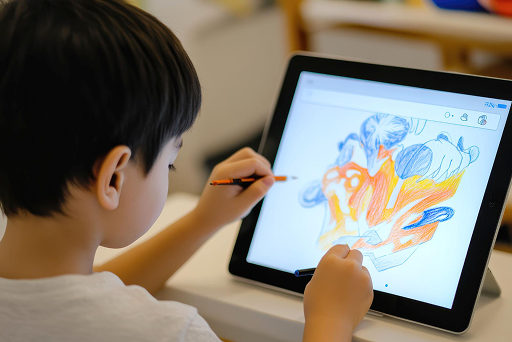
Digital tools can either stifle or unlock creativity. The trick is to move from passive consumption to active creation.
Use screens creatively by:
- Encouraging apps that let children draw, animate, or compose music.
- Helping them make a simple slideshow, comic strip, or mini “documentary” about their day.
- Co-viewing and then discussing: “How would you change that ending?”
Set clear time limits, but within those limits, guide them towards activities that require thinking, designing and creating – not just tapping and scrolling.
5. Celebrate Effort, Not Perfection
Creativity blossoms where children feel safe to experiment and make mistakes.
Shift your feedback towards:
- Process: “You tried three different ways to build that tower – that’s real perseverance.”
- Curiosity: “I love how you mixed those colours – what made you choose them?”
- Risk-taking: “That was a brave idea. What else could we try next time?”
When children learn that creativity is about exploring, not getting it “right”, they are more likely to take intellectual risks in every area of learning.
How Regent International School Malaysia Nurtures Creativity
While home is a powerful space for creativity, the right school environment multiplies the impact.
Regent International School Malaysia offers a high-quality Cambridge International curriculum from preschool to A-Levels, with a strong commitment to holistic development and global-mindedness.

Here’s how Regent International School Malaysia connects directly to creativity in your child’s daily learning:
- Creativity as a 21st-Century Skill: Regent explicitly highlights critical thinking, creativity and confidence as core skills cultivated through its Cambridge IGCSE programmes and wider school culture.
- Holistic Development and Co-Curricular Life: Through a wide range of co-curricular and after-school clubs, students explore talents in the arts, innovation and entrepreneurship – building creativity alongside academic strength.
- Real-World Creative Opportunities: Events such as art competitions and the Arts and Crafts Club at Regent showcase students’ artistic expression while linking creativity to sustainability and community impact.
- Global Network, Modern Facilities: As a member of the globally acclaimed Global Schools Group, Regent benefits from shared best practices, international events celebrating innovation and creativity and modern, well-equipped campuses.
In short, Regent International School Malaysia doesn’t treat creativity as an “extra”. It’s woven into everyday classroom practice, projects and campus life – perfectly complementing the creative habits you build at home.

FAQs
1. How can I encourage creativity in my child every day?
Offer open-ended activities (drawing, building, role-play), ask imaginative “what if” questions and give them time to explore ideas without worrying about mistakes.
2. Does creativity really help with cognitive skills?
Yes. Creative tasks involve planning, memory, flexible thinking and problem-solving – all key cognitive skills that support academic subjects like maths, science and literacy.
3. Can creative play support speech therapy and language development?
Creative play can complement speech therapy by giving children fun ways to practise sounds, vocabulary and sentence structures, helping build confidence and richer language development at home.
4. How much structure should I give to creative time?
Offer gentle structure (a prompt, a theme or a challenge) but leave the solution open. Too many rules can stifle creativity; too few can leave children unsure where to start.
5. What kind of school environment is best for a creative child?
Look for schools that emphasise holistic development, 21st-century skills (creativity, critical thinking, collaboration) and rich co-curricular opportunities – like Regent International School Malaysia, which blends academic excellence with creative, real-world learning.
Make Creativity a Daily Habit
Supporting creativity in your child’s daily routine is less about big, dramatic projects and more about small, consistent invitations to imagine, explore and express. From storytelling at breakfast to open-ended play, you’re quietly strengthening their cognitive skills, language development and confidence to think differently.
When this home environment is paired with a school like Regent, where creativity, critical thinking and holistic growth are at the heart of the Cambridge pathway – your child gains a powerful foundation for the future.
Want to give your child a learning environment that nurtures both creativity and academic excellence? Write to us for more information.
Book a campus tour today, and discover how your child’s imagination can progress every single day.