Save up to 75% on tuition fee with our Free Scholarship Exam on 24th August. Register Now.

Table of Contents

This article talks about:

  1. International learners choose among several “levels education” path options: the International Baccalaureate Diploma Programme (IB), the Cambridge IGCSE/Cambridge pathway and other Cambridge-aligned levels.
  2. Understanding the key differences—curriculum approach, age/life stage, assessment style—helps parents make informed decisions. (The “IB vs IGCSE vs Cambridge” comparison.)
  3. The role of extra-curricular activities is integral: schools offering rich clubs, service, sport and arts support holistic development beyond academic certification.
  4. At Regent International School Malaysia, the Cambridge pathway is clearly emphasised. Students follow Cambridge Primary, Lower Secondary, IGCSE and Pre-University levels, with a strong culture of extracurricular-rich, globally-minded, values-based education.
  5. As a parent, your role is to investigate the school’s curriculum, progression routes, how “levels education” map from early years to university and how the school supports transitions and holistic student growth.


Making sense of the different international curriculum options can feel overwhelming for parents: what exactly is the difference between IB and IGCSE? How does the Cambridge pathway work? What does “levels education” mean in this context? This guide walks you through the background, key features and practical implications of each programme, compares “IB vs IGCSE vs cambridge”, highlights the importance of extra-curricular activities, and shows how Regent International School Malaysia aligns with these choices and supports students. By the end you should feel more confident in understanding what your child’s educational journey could look like.

What is “Levels Education” and Why It Matters

“Levels education” refers to the sequential structure of learning stages—early years, primary, lower secondary, upper secondary and pre-university (or university entry) levels. Each programme you encounter (IB, IGCSE, Cambridge A-Levels) typically corresponds to one or more of these levels.

  •   Early years / Primary: building foundations of literacy, numeracy, enquiry.
  •   Lower Secondary / Middle Years: deepening subject knowledge, starting to specialise.
  •   Upper Secondary: culminating in external examinations or certificates (IGCSE, IB Diploma etc).
  •   Pre-University / University Entrance: preparing for uni or career via A-Levels, IB Diploma or equivalent.

Understanding how a school maps its curriculum to these levels is vital. A good school will articulate: “this is our Primary curriculum, then we lead into IGCSE (levels education) and then into A-Levels or IB”. For example, Regent International School Malaysia explains its Cambridge pathway from Early Years through to A-Levels. 
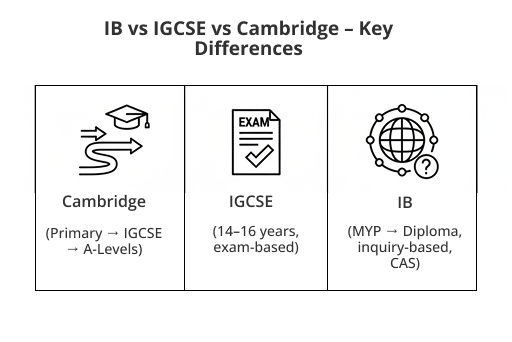
IB vs IGCSE vs Cambridge – Key Differences

When comparing “IB vs IGCSE vs cambridge”, here are the highlights:
The Cambridge Pathway (Cambridge International)

  •   Offers Cambridge Primary, Secondary, IGCSE, and Cambridge Advanced (A-Levels) levels. At Regent, this pathway is clearly outlined.
  •   Focuses on subject-based learning, external exams, global recognition.
  •   Good option if the school has a strong exam track record and you aim for international university admission.
  •   At Regent, we offer the Cambridge IGCSE curriculum for Upper Secondary Programmes that lead to globally recognised Cambridge IGCSE qualifications.

International Baccalaureate (IB)

  •   Designed to develop broad intellectual, personal, emotional, global thinking skills. Includes IB Diploma (16-19 years), often preceded by the Middle Years Programme.
  •   Emphasises enquiry, conceptual understanding, reflection, research and service (Creativity, Activity and Service – CAS).
  •   Less widely used in all Malaysian international schools (fewer authorised IB schools) compared to Cambridge.
  •   Great for students seeking a highly international, interdisciplinary education.

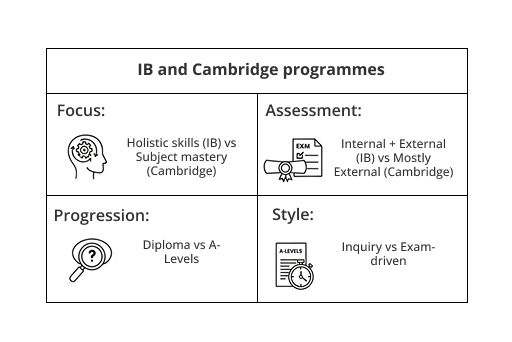
Comparing the two:

  •   Focus: Cambridge tends to be subject-specific and exam-oriented; IB is more holistic, skills-based, student-centred.
  •   Progression: Cambridge naturally leads into IGCSE → A-Levels; IB leads into Diploma or Career-related Programme.
  •   Recognition: Both are globally recognised. Choosing depends on the strength of the school and fit with the student.
  •   School availability: Cambridge is widely offered (e.g., ). IB may be offered in fewer schools.

As a parent, you should ask: Which programme does the school offer? What universities do graduates attend? How strong is the school in that pathway? At Regent, the focus is clearly on Cambridge pathways with robust results (e.g., more than 4,500 A*/A in IGCSE in the last five years). 

The Role of Extra-Curricular Activities

“Extra curricular activities” are not just add-ons. They are intrinsic to “levels education” and provide critical holistic development across all programmes, whether Cambridge or IB.

  •   Activities such as coding clubs, robotics, gardening, sport, art develop leadership, creativity, teamwork, resilience.
  •   At Regent International School Malaysia: “Regent International School offers a diverse range of extracurricular activities that ignite passion and foster personal growth among our students.”
  •   These activities complement academic programmes by enabling students to apply what they learn, develop interpersonal skills and strengthen university-applications or scholarship portfolios.
  •   When evaluating schools, ask: what clubs exist? How many students participate? Are there service programmes, leadership opportunities? These support whichever “levels education” path you choose.

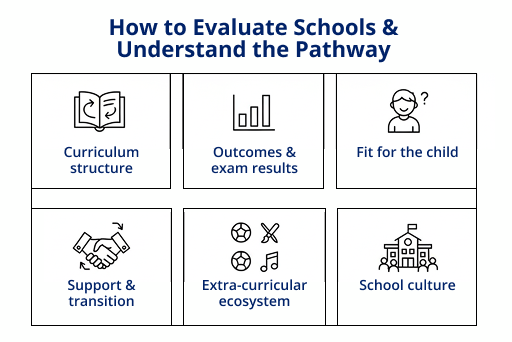
How to Evaluate Schools & Understand the Pathway

As a parent navigating this terrain, here are useful criteria:

Curriculum Structure

  •   Does the school clearly outline: early years → primary → lower secondary → upper secondary → pre-university?
  •   Which programme do they offer at each level? (E.g., Cambridge IGCSE at KS4, A-Levels at pre-university.) 

Progression & Outcomes

  •   What examination results does the school report? E.g., at Regent, more than 4,500 A*/A from IGCSE students in the last five years. Students top ranked in Malaysia and in the world.”
  •   Which universities do alumni attend?
  •   How well does the pathway lead into higher education?

Fit for Your Child

  •   Is your child stronger in structured exam environments or more comfortable with enquiry, project-based learning? That may guide whether Cambridge or IB is a better fit.
  •   What is your child’s interest in extra-curricular activities, service learning, leadership opportunities?

Support and Transition

  •   Does the school offer intervention or enrichment to support diverse learners? Regent emphasises “no-child-left-behind policy” and enrichment classes.
  •   Are there clear pathways between levels and minimal disruption when moving from IGCSE to A-Levels or equivalent?

Environment & Culture

  •   Does the school foster global citizenship, multilingualism, collaborative learning? Regent states its mission to develop “global citizens committed to excellence and compassion.”
  •   Are extra-curricular-rich, culturally-diverse, inclusive?

Why Regent International School Malaysia Stands Out

When exploring international schools and comparing curriculum pathways, Regent International School Malaysia offers several distinctive USPs in the context of “levels education”, curriculum choice and holistic development.

Strong Cambridge Focus & Proven Results

  •   Regent offers Cambridge Primary, Cambridge Secondary, Cambridge IGCSE and Cambridge Advanced (A-Levels) across its programmes.
  •   Students at Regent regularly achieve top IGCSE results: “Students top ranked in Malaysia and in the world.”

Holistic Education & Extra-Curricular Depth

  •   Regent emphasises holistic, values-based education: “holistic curriculum… develop values, knowledge, competencies and life skills.”
  •   Rich extra-curricular programme: clubs in arts, STEM, gardening, robotics, entrepreneurship and life-skills.

Affordability and Accessibility within an International Framework

  •   As part of the Global Schools Group, Regent aims to offer quality international education with accessible fee structures.

Global Perspective & University Preparation

  •   The school supports global-mindedness and offers guidance for university progression.
  •   With the Cambridge pathway, Regent ensures students are well prepared for top universities globally.

Together, these USPs make the school a compelling choice for parents looking at international “levels education” pathways—especially those leaning towards Cambridge programmes with robust extra-curricular and holistic support.

Final Thoughts

Choosing the right international curriculum path is one of the most important decisions a parent makes in navigating their child’s “levels education”. Whether you are evaluating “IB vs IGCSE vs Cambridge”, or seeking a school that supports strong academics, rich extra-curricular activities and a global mindset, it pays to research depth, ask detailed questions and visit campuses.

At Regent International School Malaysia you will find a school that clearly maps educational levels, offers a proven Cambridge curriculum, supports personal development, and fosters a holistic, global citizen mindset. With strong examination outcomes, rich clubs and a caring culture, it stands as an excellent choice.

Explore how your child can thrive across ‘levels education’, internationally-recognised programmes and enriching extra-curricular life? Book a school tour and discover Regent’s curriculum in action, meet teachers and see how the Cambridge pathway could work for your child’s future.

FAQs

The IB Diploma is an 16-19 two-year holistic programme emphasising enquiry, research and global perspectives. IGCSE is for 14-16 year olds as part of the Cambridge International Curriculum, culminating in subject certificates. “Cambridge” often refers to the overall pathway (Primary, Secondary, IGCSE, A-Levels). Understanding the student age, subject model and destination is key.

Typically: primary (5–11 years), lower secondary (11–14 years), upper secondary (14–16 years, e.g., IGCSE), pre-university (16–18/19 years, e.g., A-Levels or IB Diploma). Each school may vary slightly.

Very important. They build leadership, creativity, service and personal growth—key when universities review applications and when students progress beyond pure academics. A strong programme integrates them alongside exams.

Consider your child’s learning style (structured vs enquiry), the school’s strength in each pathway, university destinations and whether the school offers robust extra-curricular support and holistic development.

Because Regent offers a transparent Cambridge pathway from Early Years to A-Levels, achieves strong academic results, emphasises holistic development and extra-curricular richness, and aims for accessible international education through the Global Schools Group network.